Electroless Nickel Plating Singapore
化学镀镍
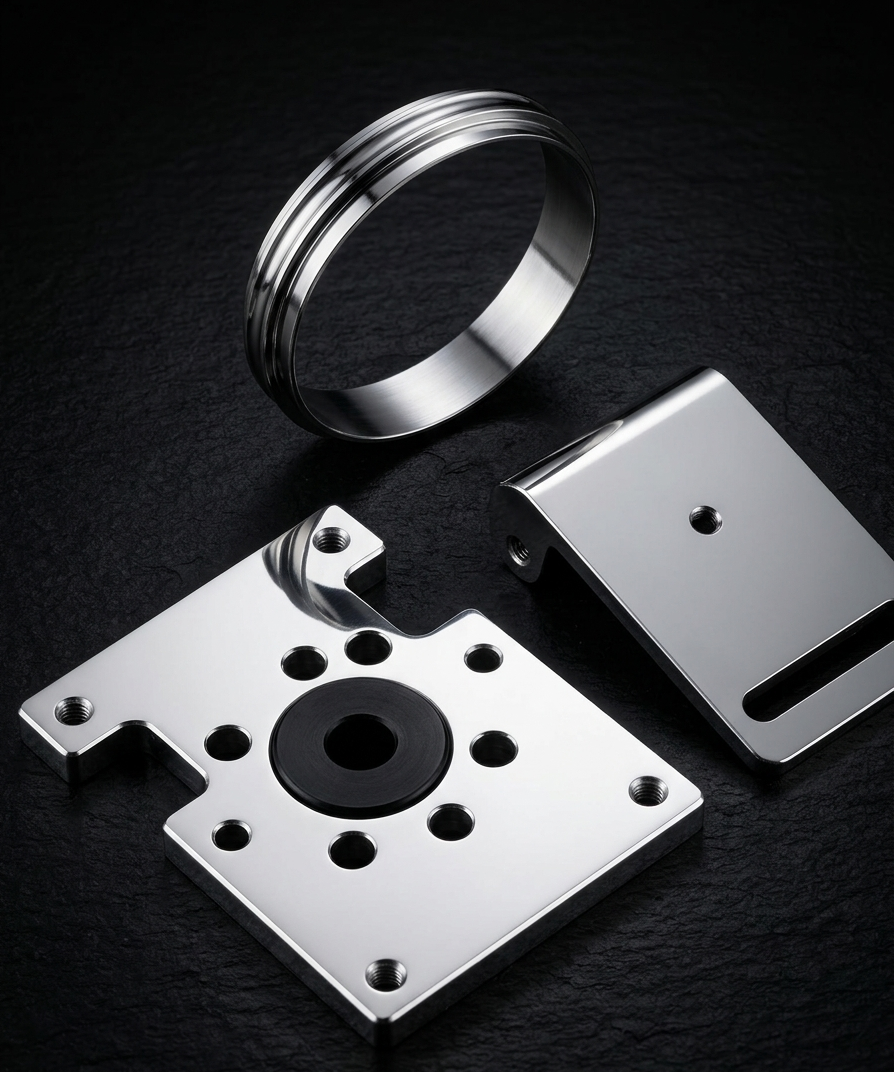
Auto-catalytic nickel-phosphorus plating delivering uniform thickness on complex geometries, with medium- and high-phosphorus grades for hardness or corrosion resistance.
Active Treatment provides commercial electroless nickel plating in Singapore for precision and production components. Electroless nickel (EN) is an autocatalytic chemical process that deposits a nickel-phosphorus alloy without electric current, producing even coverage on bores, threads, blind holes, and complex internal geometries.
Electroless Nickel vs Electrolytic Nickel Plating
This service is electroless nickel plating, not generic electrolytic nickel electroplating. Conventional electrolytic plating uses electric current, so deposit thickness tends to vary between edges and recesses. EN uses a chemical reducing reaction and is selected where uniform coating thickness across complex geometry and predictable dimensional build are important.
Medium-Phosphorus EN for Hardness and Wear
Medium-phosphorus EN (6–9% P) provides as-deposited hardness of HV 500–550 and can reach approximately HV 900 after heat treatment at 350–400°C. It is used for tooling, moulds, hydraulic components, and engineering parts where hardness and abrasion resistance are priorities.
High-Phosphorus Electroless Nickel for Corrosion Resistance
High-phosphorus EN (10–13% P) has a near-amorphous microstructure and is selected for resistance to acidic, alkaline, and saline environments. Published properties include 1,000+ hours neutral salt-spray resistance to ASTM B117 and magnetic permeability below 1.001. Applications include chemical-processing, marine, fluid-path, and sensitive electronic components.
Medium- vs High-Phosphorus EN Coating
The two grades trade hardness for corrosion protection. Choose medium-P for wear-critical parts and high-P for aggressive chemical or marine exposure:
| Property | Medium-P (6–9%) | High-P (10–13%) |
|---|---|---|
| As-deposited hardness | HV 500–550 | HV 450–500 |
| Salt-spray resistance (ASTM B117) | 200–500 hours | 1,000+ hours |
| Microstructure | Microcrystalline | Near-amorphous |
| Magnetic response | Slightly magnetic | Non-magnetic |
| Best for | Wear & hardness | Corrosion & chemicals |
Materials, Thickness and Precision Applications
EN can be applied to steel, stainless steel, aluminium, and copper alloys; aluminium requires zincate pre-treatment. The published thickness range is 5–50 µm, with 12–25 µm typical for many engineering applications. Typical parts include valves, pumps, hydraulic and pneumatic components, moulds and dies, fasteners, shafts, and semiconductor equipment parts such as wafer-handling arms, vacuum chucks, gas-line components, and precision jigs.
Request an Electroless Nickel Plating Quote
Send the substrate and grade, drawing, quantity, current surface condition, target thickness, phosphorus grade if specified, operating environment, critical dimensions, masking, heat-treatment, testing, and delivery requirements. Active Treatment will review the part and provide a commercial quotation for the appropriate EN coating.
Key Benefits
- Perfectly uniform thickness on any geometry — blind holes, bores and threads included
- Medium-P hardness HV 500, up to HV 900 after heat treatment
- High-P grade delivers 1,000+ hours salt-spray corrosion resistance
- Non-magnetic high-phosphorus deposit for sensitive assemblies
- Plates steel, stainless steel, aluminium and copper alloys
- RoHS compliant with predictable, easy-to-hold tolerances
Specifications
| Substrate | Steel, stainless steel, aluminium, copper alloys |
|---|---|
| Plating thickness | 5–50 µm |
| Phosphorus content | 6–9% (medium-P) or 10–13% (high-P) |
| As-deposited hardness | HV 450–550 |
| Post-heat-treat hardness | HV 850–1000 |
| Corrosion resistance (high-P) | 1000+ hours NSS (ASTM B117) |
| Magnetic permeability (high-P) | <1.001 (non-magnetic) |
Frequently Asked Questions
What is electroless nickel plating?
Electroless nickel plating is an auto-catalytic chemical process that deposits a uniform nickel-phosphorus alloy onto a part without any electric current. Because the reaction is chemical rather than electrical, the coating builds to an even thickness on every surface — including bores, threads, blind holes, and complex internal geometries that conventional electroplating cannot coat uniformly.
How does electroless nickel differ from electroplating?
Conventional electroplating relies on electric current, so the deposit concentrates on edges and high points and thins out in recesses. Electroless nickel uses a chemical reducing reaction instead, depositing the same thickness on every surface regardless of shape. The result is true uniform coverage on complex parts and a hard, non-magnetic nickel-phosphorus deposit.
What is the difference between medium and high phosphorus EN?
Medium-P (6–9%) EN has higher as-deposited hardness and better wear resistance. High-P (10–13%) EN has lower crystallinity (near-amorphous), offering superior corrosion resistance in aggressive chemical environments. Choose high-P for chemical or marine exposure, medium-P for wear applications.
Can electroless nickel be plated on aluminium?
Yes. Aluminium requires a zincate pre-treatment before EN plating to ensure adhesion. We perform this in-house. Please specify the alloy so we can select the appropriate pre-treatment.
What does heat treatment do to electroless nickel?
Heat treatment at 350–400°C converts the amorphous nickel-phosphorus deposit to a crystalline Ni3P structure, increasing hardness from ~HV 500 to ~HV 900. This also improves adhesion but slightly reduces corrosion resistance.
Is electroless nickel suitable for semiconductor components?
Yes. Our EN line meets the purity requirements of the semiconductor sector. We plate wafer handling arms, vacuum chucks, and precision jigs regularly.
How do I specify the EN thickness for my application?
Typical engineering applications use 12–25 µm. Wear-critical applications may specify up to 50 µm. For corrosion protection only, 5–10 µm is often sufficient. We can advise based on your operating environment.
Request a Quote
Contact Active Treatment Pte Ltd in Singapore for Electroless Nickel Plating Singapore. Call +65 6352 9846 or email activetreatment88@yahoo.com.sg.